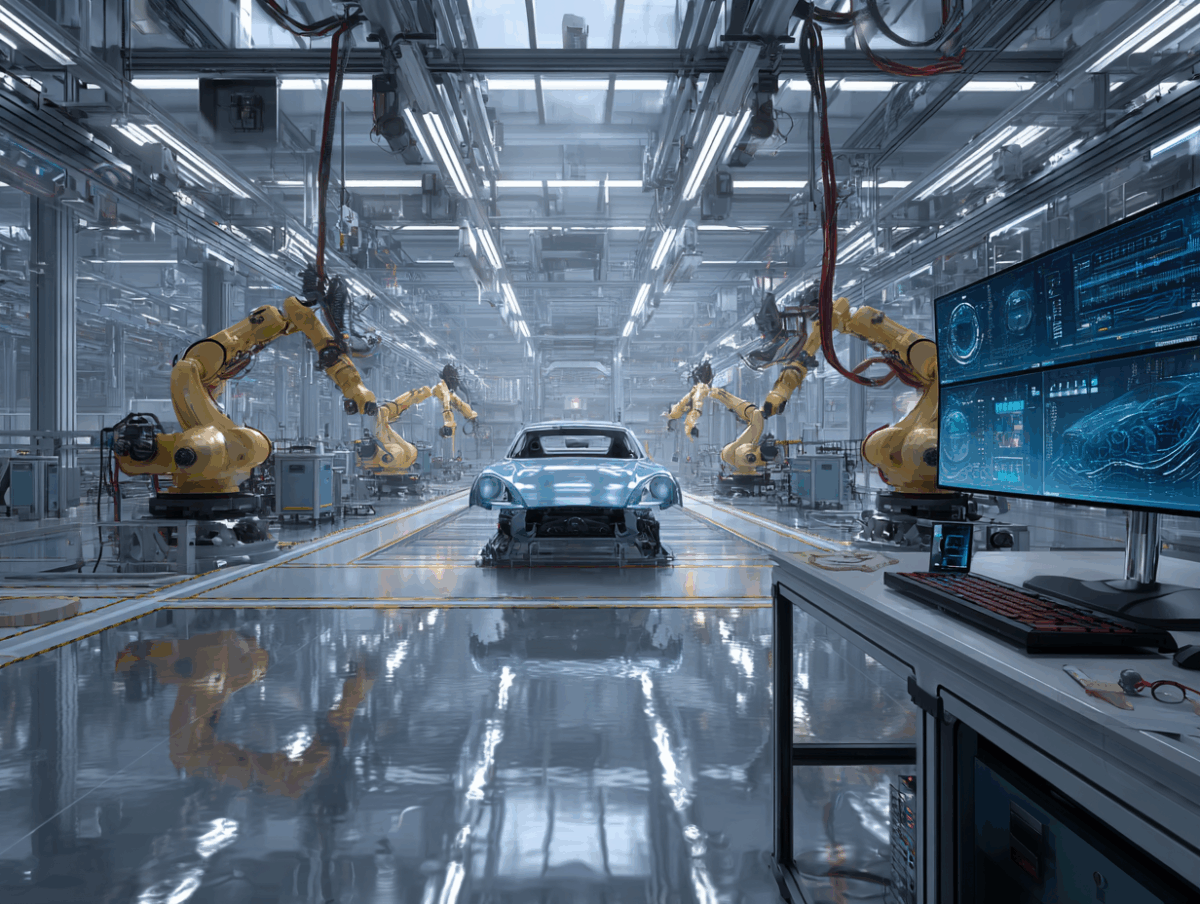
The Automotive Talent Crisis: Why Skilled Labor Will Define Competitiveness in the Next Decade

The automotive industry is moving into a decade defined by electrification, automation, software-defined vehicles, and an unprecedented level of manufacturing complexity. Yet amid billions of dollars in announcements around new EV platforms and factory modernization, a far more immediate constraint is emerging—one that threatens uptime, quality, and the ability of OEMs and Tier-1 suppliers to transform at the pace the industry now demands.

The real bottleneck is talent.
 Specifically, the shrinking pool of skilled maintenance, technical, and manufacturing labor required to operate and support the modern automotive plant.

While technology dominates industry headlines, day-to-day execution remains the differentiator. The ability to maintain robots, troubleshoot automated systems, interpret data, stabilize shift performance, and keep assets running will ultimately define who wins. This is not an HR issue. It is an operational and strategic risk with direct consequences for throughput, quality, transformation, and financial performance.

The Scope of the Crisis

Aging Workforce and Limited Pipeline

The core of the technical workforce—maintenance technicians, electricians, millwrights, controls specialists, robotics techs—is aging. A large portion will retire in the next 5–10 years. At the same time, enrollment in trade and technical programs has declined for more than a decade. Fewer young workers are entering industrial roles, and even fewer possess the hybrid mechanical-electrical-digital skills required in modern automotive plants.

Rising Complexity Across Plants

Today’s plants are filled with advanced robotics, high-voltage EV systems, power electronics, PLC networks, vision systems, AMRs and AGVs, battery pack lines, and increasingly software-driven processes. The skill requirements have grown rapidly, but the capability of the incoming workforce has not kept pace.

More Technology, Fewer People Who Can Run It

EV platforms, ADAS modules, and software-defined architectures introduce new testing, assembly, and diagnostic demands. Battery lines and power electronics require specialized knowledge. And predictive maintenance, AI, and digital twins only create value if the workforce can operate, interpret, and respond to them.

Why This Has Become a Strategic Threat

Direct Impact on Uptime and Throughput

Skilled maintenance shortages immediately translate into longer downtime events, inconsistent shift performance, and unstable throughput. A single unresolved issue can cascade into hours of lost production—especially in tightly sequenced EV and powertrain operations.

Quality and Safety Risks

Inexperienced staff increases the risk of assembly defects, misaligned processes, and errors in high-voltage and electronics operations. Tribal knowledge—much of it undocumented—is leaving plants as senior technicians retire.

Transformation Efforts Lose Momentum

Some OEMs are investing in automation and digital transformation, but these initiatives often stall when the workforce cannot absorb new technologies. The tools may exist, but the capability to run them consistently across shifts and sites is not yet in place. This mismatch between technology ambition and workforce readiness will be explored further in a future topic.

Symptoms OEMs Are Seeing Today

Across the industry, the same patterns keep repeating:

  • Persistent understaffing in skilled trades and maintenance roles
  • Heavy reliance on contract labor with inconsistent standards
  • High turnover among PLC technicians, robotics specialists, and EV-related roles
  • Corrective maintenance overshadowing preventive and predictive efforts
  • Inconsistent work instructions, procedures, and troubleshooting approaches across shifts
  • Difficulty scaling digital or automation pilots across plants

These are not isolated issues—they are structural signs of a workforce model that no longer matches the complexity of the industry.

Why Traditional Approaches Are Not Working

Hiring Alone Will Not Solve It

The competition for skilled technical labor spans semiconductor, aerospace, logistics, energy, and advanced manufacturing. Raising wages alone does not create new talent, and contractors fill gaps but rarely build long-term capability.

Training Is Not Keeping Up With the Technology Curve

Most OEMs still rely on classroom-based training disconnected from real equipment. Skills do not advance fast enough to match the requirements of automation-heavy EV lines and software-driven systems.

Every Plant Operating Independently

Many OEMs still allow each site to build its own maintenance practices, skill matrices, and performance expectations. The result is inconsistent capability and widely variable operational results.

What High-Performing OEMs Are Doing Differently

The leaders are shifting from short-term staffing fixes to long-term capability development that integrates operations, training, technology, and workforce planning. They are building:

1. A Unified Technical Skills Framework Across All Plants

A consistent set of roles, certifications, and competency levels—from mechanical and electrical fundamentals to robotics, automation, and high-voltage EV systems.

2. Predictive Maintenance Talent, Not Just Predictive Maintenance Tools

Technicians trained to interpret sensor data, diagnose equipment degradation, and apply structured troubleshooting methods.

3. Modern Training Models

Simulation-based learning, AR/VR-enabled procedures, digital twins for troubleshooting, and OEM-specific technical academies that accelerate skill development.

4. Systematic Capture of Tribal Knowledge

Documenting expert procedures through video, digital workflows, and on-machine guidance to create standardized best practices across shifts and regions.

5. Strategic Partnerships, Not Transactional Ones

Collaborating with equipment suppliers, technical colleges, and integrated maintenance service partners to build long-term capability rather than short-term headcount.

A Practical Roadmap for the Next 12–24 Months

OEMs seeking near-term impact can focus on seven foundational steps:

  1. Assess the talent gap—skills, staffing levels, retirements, and shift-to-shift variability.
  2. Build a unified competency model tied to specific equipment, processes, and technologies.
  3. Establish an internal technical academy for EV, robotics, automation, and predictive systems.
  4. Deploy AR/VR and simulation-based training for complex or safety-critical operations.
  5. Standardize maintenance procedures and skill requirements across all plants.
  6. Align suppliers and partners around performance, uptime, and capability building.
  7. Integrate workforce capability metrics into downtime, OEE, and quality analysis.

These steps create the foundation for consistent execution, stable operations, and faster adoption of new technologies.

Conclusion: Talent Is Now a Competitive Advantage

The automotive industry is transforming faster than its workforce can evolve. Technology will continue to accelerate, but without a skilled and reliable technical workforce, the value of that technology will go unrealized.

OEMs that treat talent as a strategic capability—not a staffing problem—will hold a structural advantage in uptime, quality, cost, and transformation speed. Those that do not will find themselves constrained, regardless of how advanced their technology roadmap appears on paper.

In the decade ahead, skilled labor is not just a requirement—it is a core differentiator.

Why Most AI Strategies Fail

Every executive I speak with believes AI will transform their industry. Many are right.

Yet despite billions invested annually, most AI initiatives quietly fail—not because the algorithms don’t work, but because the strategy doesn’t exist. After advising manufacturing leaders, enterprise software CEOs, and technology companies through AI transformations, I see the same pattern: organizations that succeed treat AI as a business strategy problem. Those that fail treat it as a technology project.

Here are the three reasons most AI strategies collapse—and what winning companies do differently.

Mistake #1: Technology-First Thinking

Most AI initiatives begin the same way:

“We need AI. Let’s hire data scientists. Let’s choose a platform. Let’s run a pilot.”

What’s missing is clarity on:

  • Who the customer actually is
  • What decision or workflow matters most
  • Where real economic leverage exists
  • How the company will monetize the outcome

AI is not a product. It’s an enabler. When companies design solutions before defining strategy, they build impressive systems that solve irrelevant problems.

What Works Instead: Strategy-First AI Design

High-performing AI programs start with three questions:

Where to Play – Which customer, which use case, which part of the value chain?

How to Win – What outcome creates advantage that competitors can’t easily replicate?

How to Deliver – What organizational, technical, and commercial systems must change?

One global industrial company recognized that manufacturing customers faced massive unplanned downtime costs but had no clear strategy for how to serve that market with AI-powered predictive maintenance. We started with market assessment, customer segmentation, competitive positioning, and business model design. Only then did we architect the technical solution.

The result: a comprehensive go-to-market strategy with clear differentiation, realistic economics, and a phased implementation roadmap ready for board presentation.

AI succeeds when it’s embedded in strategy from day one—not layered on top afterward.

Mistake #2: No Governance, No Operating Model

AI leaders consistently underestimate how damaging organizational ambiguity can be.

Common patterns:

  • No executive owns AI end-to-end
  • No process for model validation or monitoring drift
  • No data governance standards
  • No risk framework or compliance controls
  • No roadmap accountability
  • No economic scorecard

Without governance, AI becomes a collection of science experiments instead of a business system.

What Works Instead: AI as Infrastructure, Not Experiment

Successful companies run AI like any critical capability:

  • Clear executive ownership and decision rights
  • Defined operating rhythms for review and adjustment
  • Model governance standards for validation and monitoring
  • Security and compliance checkpoints built into workflows
  • Maturity-based rollout roadmap with clear gates
  • Explicit accountability for business outcomes

In one engagement, a logistics software company believed their edge was moving fast with small features. But that approach couldn’t scale to enterprise customers who needed implementation rigor and predictable deployments. We introduced enterprise development methodology and formal governance. The team worried it would kill their speed. Instead, it made their innovation deployable at scale—driving triple-digit revenue growth funded entirely from operations.

AI without governance scales risk faster than value.

Mistake #3: No ROI Model = No Executive Support

Here’s the uncomfortable truth: Executives don’t resist AI. They resist uncertainty.

AI strategies fail when they show capability but not economics. Too many teams present:

  • PowerPoint demos instead of unit economics
  • Models without cost-to-serve analysis
  • Pilots without CFO-credible P&L projections
  • Value narratives with no financial sensitivity analysis

Without ROI discipline, AI never becomes operational infrastructure—it stays a science project that loses funding when budgets tighten.

What Works Instead: CFO-Grade AI Economics

Winning teams build ROI models that answer hard questions:

  • What does customer value creation actually look like?
  • How does cost-to-serve change at scale?
  • What’s the relationship between adoption velocity and revenue growth?
  • What happens to margins as we deploy across segments?
  • What are our downside scenarios if key assumptions miss?

I’ve seen companies with excellent AI technology struggle because they couldn’t articulate the business case. And I’ve seen companies with modest technical capabilities win because they understood their customers’ economics cold. They knew exactly how much their solution saved in downtime costs, how that compared to implementation expenses, and what the payback period looked like.

When one mid-market software company made the hard decision to raise prices 80-120% while focusing exclusively on high-value segments, the team worried they’d price themselves out of the market. Instead, revenue growth returned after three years of stagnation, leading to a strategic acquisition at a premium multiple.

Strategy creates scale. Economics creates confidence.

The Fix: Strategy Before Systems

AI works when companies flip the sequence.

Instead of:
 Technology → Use Case → Governance → ROI

Do this:
 Strategy → Economics → Operating Model → Technology

What This Actually Looks Like:

1. Define Where AI Creates Leverage (Strategy)
 Don’t ask “where can we use AI?” Ask “where does our business model break without better intelligence?” Map the workflows, decisions, and bottlenecks where prediction, optimization, or automation creates measurable advantage.

2. Build the Business Case (Economics)
 Model the revenue impact, cost reduction, or capital efficiency gain. Include implementation costs, ongoing operational expenses, and realistic adoption curves. If the CFO wouldn’t approve the investment, the AI strategy isn’t ready.

3. Design the Operating Model (Governance)
 Define who owns what, how models get validated and monitored, how data flows and is governed, what controls exist, and how performance gets measured. Without this, your pilot will never scale.

4. Choose the Technology (Architecture)
 Only now do you select platforms, vendors, and build-versus-buy decisions. With strategy, economics, and governance clear, technology choices become obvious.

Final Thought

AI is not your differentiator. Your strategy is.

AI simply reveals whether your strategy is good enough to scale.

If you treat AI as software, you’ll get tools.
 If you treat AI as strategy, you’ll build advantage.

Before You Invest in AI, Ask:

Do we know exactly where AI creates business leverage, or are we chasing trends?

Do we have governance frameworks in place, or are we hoping pilots figure themselves out?

Do we have CFO-grade ROI math, or are we running on optimism?

Do we have operating clarity and accountability, or are we still experimenting?

If the answers aren’t clear, the technology won’t save you. It never does.

Ready to Build AI Strategy That Actually Works?

I help executives align AI initiatives with business strategy, design governance that enables speed, build ROI frameworks that pass CFO scrutiny, and operationalize innovation at scale.

If you’re serious about making AI deliver measurable business results—not just impressive presentations—let’s talk.

Schedule a Conversation

Logo